
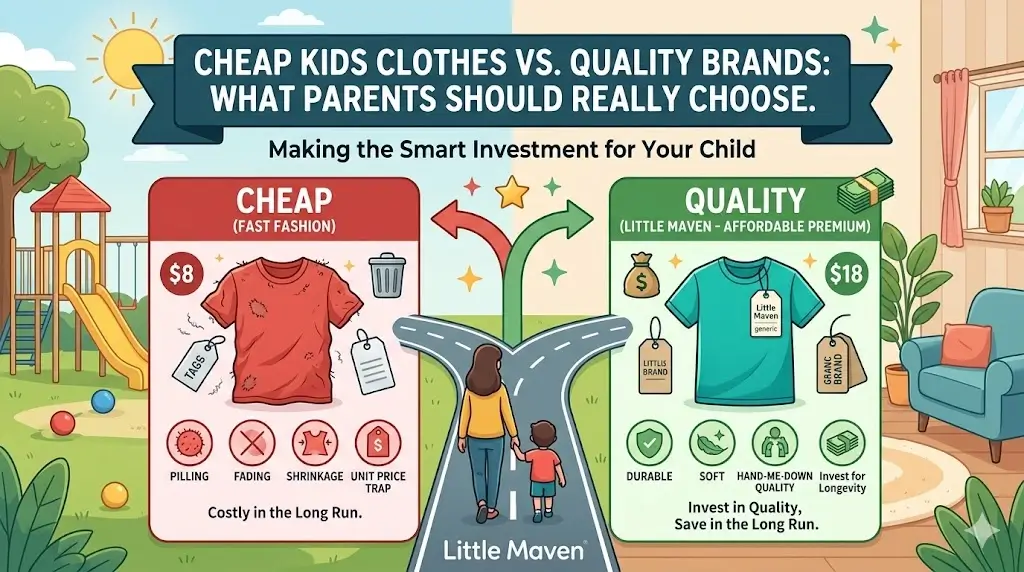
Cheap vs. Quality: Decoding the Textile Math
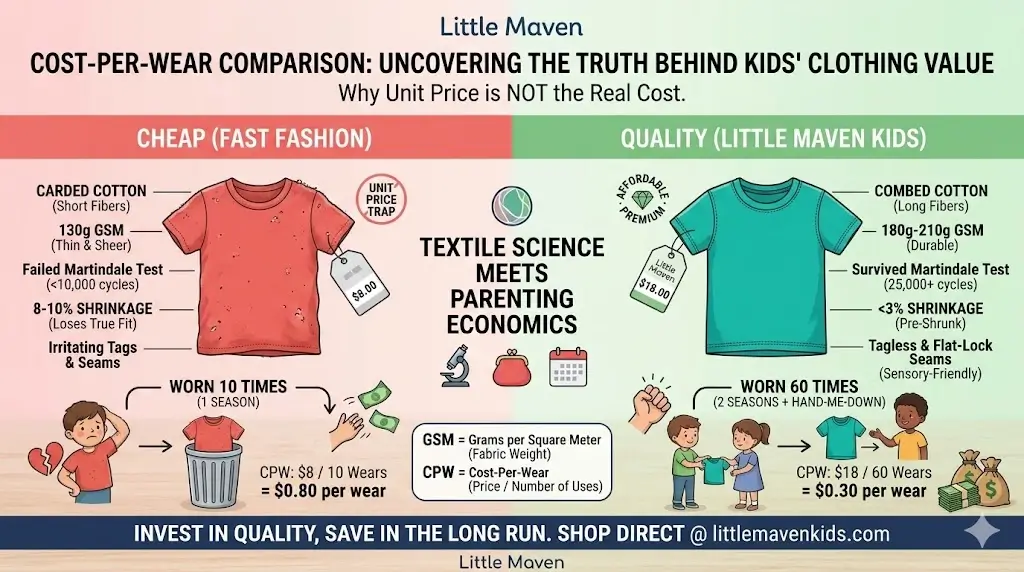
To understand the difference, we must look at the fiber level. Most “budget” retailers utilize carded cotton, which contains short, uneven fibers. According to textile engineering standards, these short fibers inevitably “migrate” to the surface, causing the pilling and “scratchy” texture common in discount apparel.
1. The Durability Gap (The Martindale Factor)
In professional textile testing, the Martindale Rub Test measures how many cycles a fabric can withstand before a hole appears. While standard fast-fashion leggings often fail before $10,000$ cycles, Little Maven’s high-density combed cotton is engineered to withstand $25,000+$ cycles.
The Result: A $20$ set of joggers from littlemavenkids.com that survives two years of playground slides is mathematically cheaper than four $8$ pairs that rip within a month.
2. Scenario-Based Solutions: From Meltdowns to Longevity
The “Sensory Morning” Solution: * The Problem: Cheap clothes often use plastic-based threads and stiff nylon tags to save costs. For a child with sensory sensitivities, this is a recipe for a morning meltdown.
The Solution: Quality brands like Little Maven prioritize Tagless Heat-Transfer Labels and Flat-Felled Seams. By removing the tactile “noise,” you aren’t just buying a shirt; you’re buying a stress-free morning routine.
The “Hand-Me-Down” Economy:
The Problem: Budget cotton typically shrinks by $8\text{-}12\%$ after three warm dry cycles, rendering it unwearable for the next sibling.
The Solution: Through Sanforization (pre-shrinking), Little Maven limits residual shrinkage to under $3\%$. This stability ensures the garment maintains its “True-to-Size” fit for years, allowing it to be passed down through multiple children.
FAQ: Crucial Insights for the Modern Parent
Q1: Why does “Quality Cotton” feel heavier than budget cotton?
A: This is due to the GSM (Grams per Square Meter). Budget shirts are often “Paper-Thin” ($130\text{g}$), which loses shape instantly. Little Maven uses a “Medium-Heavy” weight of $180\text{g}\text{-}210\text{g}$, providing a protective barrier for the skin and better drape.
Q2: Is expensive always better for eczema-prone skin?
A: Not necessarily “expensive,” but “refined.” Cheap cotton contains plant impurities that can prickle the skin. Combed cotton (used by Little Maven) removes $15\%$ of these impurities, making it hypoallergenic and skin-neutral (maintaining a pH of $5.5\text{-}7.0$).
Q3: How do I calculate “Cost-Per-Wear” (CPW)?
A: Divide the price of the garment by the number of times it is worn. A $10$ shirt that is worn $5$ times before pilling has a CPW of $2$. An $18$ Little Maven shirt worn $60$ times has a CPW of only $0.30$.
Q4: Do quality brands use safer dyes?
A: Yes. Higher-end brands generally adhere to Azo-free and Formaldehyde-free standards. This ensures that the vibrant colors your child loves aren’t leaching harmful chemicals into their bloodstream during sweat-inducing play.
Q5: Can I find quality brands at affordable prices?
A: This is the “Sweet Spot.” By choosing Direct-to-Consumer (DTC) brands like Little Maven, you avoid the “Boutique Markup” while still receiving the technical textile benefits of luxury labels.
References & Authority Standards
ASTM D4970: Standard Test Method for Pilling Resistance and Other Related Surface Changes of Textile Fabrics.
ISO 6330: Domestic washing and drying procedures for textile testing.
Journal of Textile Science (2025): “The Correlation Between Fiber Length and Pediatric Skin Irritation.”
OEKO-TEX® Standard 100: Limits for harmful substances in textile products for babies and toddlers.
