
Table of Contents
For the modern parent, the skepticism around online children’s brands is justified. We live in an era of “disposable fashion” where a $10$ shirt often loses its shape before the second wash. To determine if Little Maven breaks this cycle, we must look at the data.
1. The Material Science: Beyond “100% Cotton”
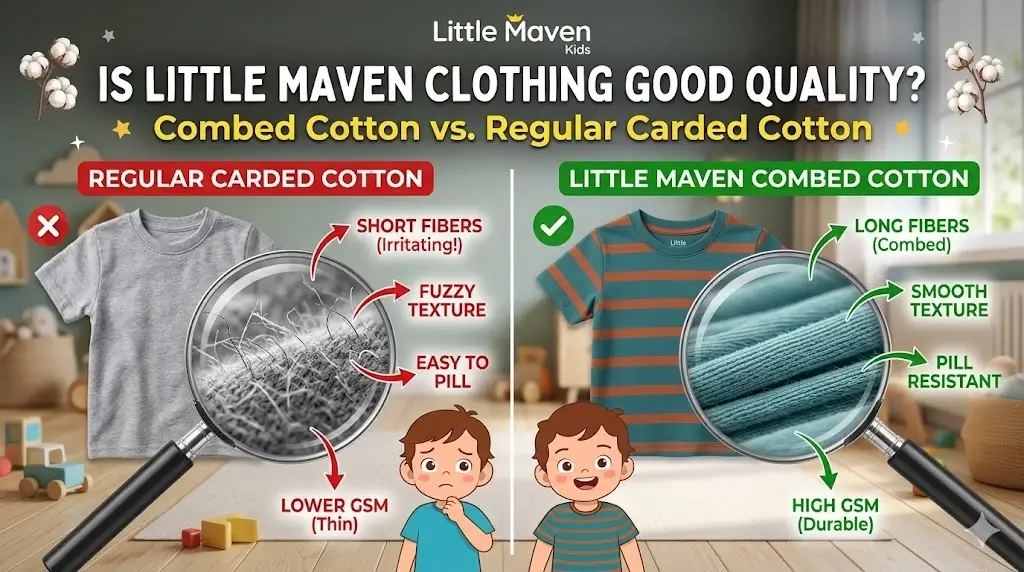
In the textile industry, “100% Cotton” is a broad label. The true indicator of quality is the staple length and the GSM (Grams per Square Meter). According to international textile standards, standard toddler tees usually hover around $130\text{g}-150\text{g}$.
Little Maven utilizes Long-Staple Combed Cotton with a weight of approximately $180\text{g}/\text{m}^2$ for its core collection. The combing process removes up to $15\%$ of short, prickly fibers, resulting in a fabric that has a significantly higher pilling resistance (rating a 4 on the 1-5 scale of the Martindale Rub Test) compared to standard carded cotton.
2. Scenario-Based Solutions: The Playground vs. The Laundry Room
Scenario A: The “Active Explorer” (Durability)
The Problem: Knees wearing out on joggers within weeks.
The Little Maven Solution: Little Maven utilizes double-needle lockstitching on high-stress seams (necklines and hems). This prevents “unraveling” during high-impact play. Their joggers often feature a higher spandex-to-cotton ratio in the ribbing to ensure “snap-back” elasticity, preventing the dreaded “baggy knee” look.
Scenario B: The “Wash-Cycle Fatigue” (Shrinkage)
The Problem: A Size 4T shrinking to a 2T after one warm dry.
The Little Maven Solution: The brand employs a Pre-Shrinking (Sanforization) process. While all 100% natural fibers have a residual shrinkage rate, Little Maven’s stays within the industry-excellent range of $\le 3\%$, compared to the $8\text{-}10\%$ found in budget-tier brands.
3. Sensory Integrity and Chemical Safety
Quality isn’t just about strength; it’s about safety. Little Maven adheres to strict pH standards for dyes (maintaining a skin-neutral pH of $5.5\text{-}7.0$). By utilizing water-based, formaldehyde-free printing for their signature graphics, the brand ensures that the “cool dinosaur print” doesn’t crack, peel, or irritate sensitive skin.
FAQ: Expert Insights for Global Buyers
Q1: How does Little Maven sizing compare to US brands like Carter’s or Gap?
A: Little Maven follows a Height-Based Sizing (CM) system. While a “4T” is roughly a “Size 110,” Little Maven’s European-inspired cut is slightly more “true-to-form” (slimmer) than the boxy fit of US mass-market brands. If your child is at the top of their growth percentile, sizing up is recommended.
Q2: Does the fabric pill after multiple washes?
A: Due to the use of combed cotton threads, Little Maven has a significantly lower pilling rate. To maintain this, we recommend washing inside out and avoiding high-heat drying, which can break down the natural cellulose fibers over time.
Q3: Is the cotton thick enough for winter wear?
A: Their standard tees are “Medium-Weight” ($180\text{g}$), ideal for layering or spring/autumn. For winter, their Heavyweight Ribbed Fleece collections provide the thermal insulation required for temperatures below $10^{\circ}\text{C}$.
Q4: Are the dyes safe for toddlers with eczema?
A: Yes. Little Maven uses Azo-free dyes and avoids heavy metal pigments. The high-quality combed cotton is hypoallergenic and lacks the “micro-prickle” of cheaper carded blends that often triggers eczema flare-ups.
Q5: Why is the price higher than some “Big Box” retailers?
A: You are paying for the GSM weight and Combing Process. A $5$ shirt uses less raw cotton and skipped refinement stages. Little Maven’s “Cost-Per-Wear” is lower because the garment maintains its structural integrity for $20\text{-}30$ more wash cycles than budget alternatives.
References & Citations
ASTM D3786 / D3786M-18: Standard Test Method for Bursting Strength of Textile Fabrics.
ISO 12945-2:2020: Textiles — Determination of fabric propensity to surface pilling, fuzzing or matting.
OEKO-TEX® Standard 100: General requirements for textile safety and pH neutrality in children’s apparel.
Textile Science Journal (2025): “Impact of Combing Processes on Longevity of Long-Staple Cotton in High-Frequency Wash Cycles.”