
Table of Contents
It happens every few months: you’re folding laundry and you find it. A hole in the knee of a brand-new pair of joggers. A T-shirt that has mysteriously shrunk two sizes and now looks like a crop top. Or that dreaded “pilling”—those tiny lint balls that make a month-old outfit look like it’s a decade old.
It’s frustrating, expensive, and a huge waste of time. But here’s the secret: it’s not that your kid is a tiny demolition expert (though they might be). It’s that most modern kids’ clothing is designed to fail.
Welcome to the era of “disposable fashion.” In this guide, we’ll go under the microscope to see why clothes wear out so fast and how you can spot the high-quality gems that actually survive childhood.
The Hidden Reasons Your Kids’ Clothes Are Falling Apart
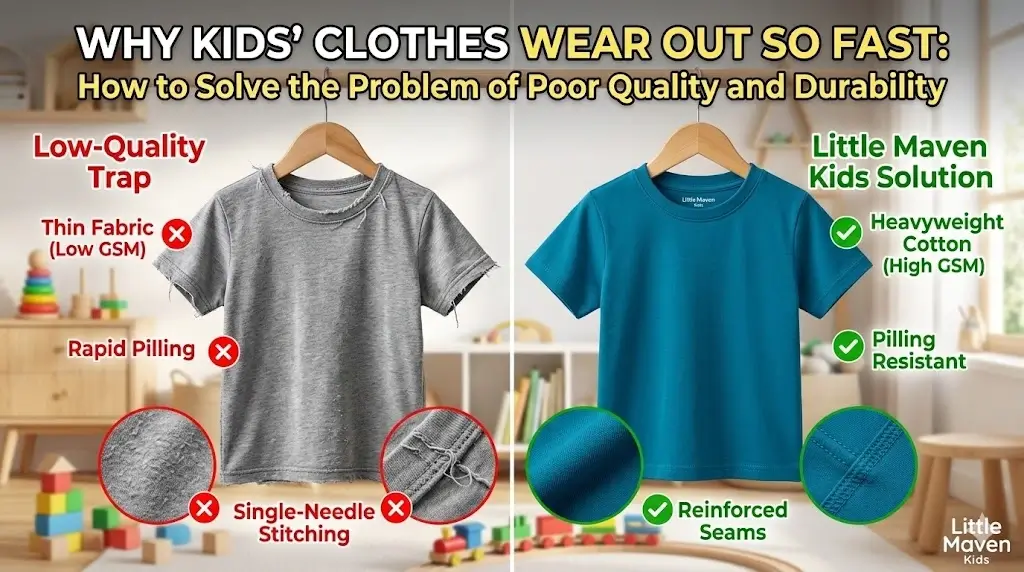
1. The Fabric Weight Trap (The GSM Mystery)
In the clothing world, we measure fabric by GSM (Grams per Square Meter). Most fast-fashion kids’ brands use fabric that is 120g–140g. It feels soft in the store because it’s thin, but after three washes, the fibers break down, and the shirt becomes see-through.
The Solution: Look for “Heavyweight” cotton. At Little Maven Kids, we use 180g–200g combed cotton. It’s thicker, stronger, and built to handle the friction of playground slides.
2. Combed vs. Carded Cotton
All cotton is not created equal. Cheap brands use carded cotton, which contains short, fuzzy fibers that easily untangle and create pills. Combed cotton goes through an extra step where short fibers are literally combed out, leaving only the longest, strongest strands. This results in a fabric that stays smooth and pill-free wash after wash.
3. The “Single-Stitch” Shortcut
Turn a cheap shirt inside out and look at the seams. If you see a single row of loose threads, that garment is on a countdown to destruction. High-quality playwear uses double-needle stitching and reinforced seams at high-stress points like the neckline and crotch to prevent unraveling.
3 Simple Tests to Identify High-Quality Clothes (Without Being a Textile Expert)
Before you click “Add to Cart” or head to the register, perform these three quick checks:
The Stretch and Snap Test: Pull the fabric firmly. Does it snap back to its original shape immediately? If it stays stretched out or looks distorted, it lacks the structural integrity to survive a day of climbing trees.
The Light Test: Hold the garment up to a light bulb. If you can see the individual threads clearly or see large gaps in the weave, it will likely shrink or warp in the dryer. A tight, dense weave is the hallmark of durability.
The Seam Tug: Give the seams a gentle tug. If you see light through the stitches, the tension is too loose, and the seam will eventually “grin” or pop open.
How Little Maven Kids Solves the Durability Problem
We didn’t just want to make cute clothes; we wanted to make “Hand-Me-Down” quality clothes. Here is how we challenge the fast-fashion status quo:
200g Heavyweight Combed Cotton: We use the gold standard of cotton to ensure our tees and joggers have “body” and strength.
Pre-Shrunk Technology: We wash and dry our fabrics before they are even sewn, so the size you buy is the size you keep.
Eco-Friendly Dyes: Cheap dyes weaken fibers. We use high-grade, non-toxic dyes that stay vibrant without making the fabric brittle.
FAQ: Solving the Durability Dilemma
Q: Why do my child’s clothes start pilling after just a few washes?
A: Pilling happens when short fiber ends tangle together. This is a sign of low-quality “carded” cotton or synthetic blends. To avoid this, always choose 100% combed cotton with a high-density knit.
Q: What is the best fabric for long-lasting, durable kids’ clothes?
A: The best choice is 180g-200g 100% Combed Cotton. It provides a natural balance of breathability for the skin and structural strength for the playground.
Q: Does “100% Cotton” always mean high quality? A: Not necessarily. You can have thin, poor-quality cotton. Always check the fabric weight and the stitch quality. If a brand doesn’t mention “combed cotton” or “reinforced seams,” they are likely cutting corners.
Stop Buying Disposable. Start Investing in Play.
Your kids work hard at playing—their clothes should work just as hard. By choosing quality over quantity, you save money, reduce waste, and ensure your child is always comfortable.
Ready to see the difference that 200g combed cotton makes? [Browse New Arrivals for Ages 2-7]